
The Beninese Collegiate Programming Contest
Solutions des problèmes résolus par mon équipe.
Le 23 Janvier s’est déroulé le concours national de programmation au Bénin BCPC. Mon équipe a terminé deuxième à l’issu de ce concours avec 8 problèmes résolus.
Dans cet article, je vais tout d’abord présenter rapidement comment fonctionne ce concours, puis je vais passer sur chaque exercice que mon équipe a résolu, pour donner une explication de notre solution durant le concours.
Le concours
Le principe du concours était le suivant:
- Plusieurs problèmes de difficultés diverses nous sont soumis
-
Chaque problème est composé:
- D’un énoncé donnant le contexte du problème, ainsi que le résultat attendu
- D’une description des entrées et sorties (contraintes (ordre de grandeur des différentes valeurs), type des données)
- D’un ou plusieurs exemples (entrée(s) et sortie(s) attendue(s))
A partir de ces informations fournies, l’objectif est de coder un programme dans un langage informatique parmi les langages proposés comme: Python 3, C++, Java et le C, qui va:
- Inclure le fichier dans lequel seront fournis les entrées (freopen(“fichier.in”,”r”,stdin); en C/C++, sys.stdin = open(“fichier.in”,”r”) en Python 3)
- Lire les entrées dans le fichier (cin pour C++, scanf pour C, input() pour Python 3 par exemple)
- Renvoyer sur la sortie standard (cout pour C++, printf pour C, print() pour python 3 …) la réponse correspondante aux entrées
Problem A. Calculator Messages
Sujet
Alex is a six-year-old boy. He was playing with his sister’s calculator and he discovered that when he rotates the calculator, some digits look like characters. This is his list:
Alex will write some digits for his mother on the calculator and she will need your help to translate them into alphabetical words.
Input
The first line contains N - the number of Alex’s words (1 ≤ N ≤ 100).
Each of the N lines contain a string Si (1 ≤ |Si| ≤ 1000) and has only digits
[0, 1, 2, 3, 5, 7, 8, 9].
|X| is the length of X.
Output
N lines; each has one string with uppercase English letters - the string you will give to Alex’s mother.

Réflexion
Pour ce problème on nous donne un dictionnaire dans lequel on associe certains chiffres aux lettres de l’alphabet, l’objectif est de traduire un nombre donné et de l’inverser.
Durant le concours, nous avons utilisé la structure dict({}) de python. Cette structure permet de faire une association entre des clés et des valeurs. Les adeptes du C++ auraient pu utiliser la structure map de la bibliothèque standard qui est l’équivalente de dict.
SOLUTION PYTHON 3:
import sys

sys.stdin = open("digits.in", "r")

dico = {'0' : 'O','1' : 'I','2' : 'Z','3' : 'E','5' : 'S','7' : 'L','8' : 'B','9' : 'G'}

n = int(input())

for _ in range(n):

    res = ""

    for i in input(): res+=dico[i] #traduction

    print(res[::-1])
Problem B. Winner
Sujet
One day, a famous website made a 1 vs 1 contest. This is a special type of contest, in which 2 contestants compete against each other in a contest that has N problems and the one who solves more problems first wins.
Mike challenged his friend Jack on who will solve more problems first.
Can you help them and tell who solved more problems first, or if there’s a tie?
Input
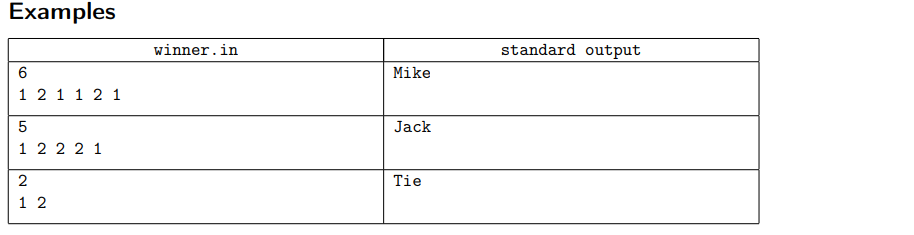
The input consists of 2 lines.
The first line contains an integer N (1 ≤ N ≤ 100) - the number of problems.
The second line contains N integers ai (1 ≤ ai ≤ 2). If ai equals 1, this means Mike solved problem number i first. If ai equals 2, this means Jack solved problem number i first.
Output
Print “Mike” if Mike solved more problems faster than Jack, or print “Jack” if Jack solved more problems faster than Mike. Otherwise, print “Tie”.
Réflexion
Le but de ce problème est de compter le nombre de ‘1’ et de ‘2’ dans une liste de N éléments composés uniquement de 1 et de 2.
-
si N1 > N2 alors Afficher(“Mike”)
-
si N2 > N1 alors Afficher(“Jack”)
-
sinon Afficher(“Tie”)
SOLUTION PYTHON 3:
import sys

sys.stdin = open("winner.in", "r")

N = input()

resultats = input().split()

N1 = resultats.count('1')

N2 = resultats.count('2')

if N1 > N2: print("Mike")

elif N2 > N1: print("Jack")

else: print("Tie")
Problem D. Largest Number
Sujet
One day, Mike was attending a lecture at his university, but he got bored so he stopped paying attention to what his professor was saying.
His professor was smart and noticed that Mike wasn’t paying attention, so he challenged him with a problem.
He wrote N digits on the board and asked him: what is the largest number that you make with these digits?
Input
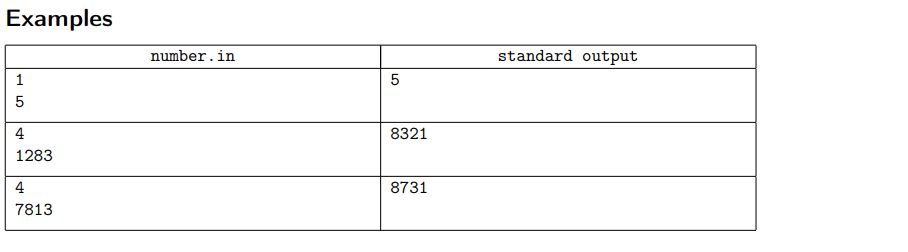
The first line contains the N (1 ≤ N ≤ 104) the number of digits written on the board.
The second contains the N digits: Di (1 ≤ Di ≤ 9).
Output
Print the largest number that can be formed by the given digits.
Réflexion
Dans une liste de N chiffres on nous demande quel est le plus grand nombre que l’on peut former en les combinant. Vous convenez avec moi qu’il faut juste trier la liste par ordre décroissant.
SOLUTION PYTHON 3:
import sys

sys.stdin = open("number.in", "r")

N = input()

digits = list(input())

digits.sort(reverse = 1)

print(''.join(digits))
Problem E. Matrix
Sujet
You are given a grid A that has N rows and N columns.
Count the number of sub-grids of grid A such that the sub-grid has X rows and X columns, and if you rotate this sub-grid 90 degrees to the right, it will remain unchanged.
Input
The first line of input has 2 integers: N and X (1 ≤ N ≤ 50) , (1 ≤ X ≤ N). The following N lines have N numbers: ai (0 ≤ ai ≤ 100).
Output
Print one integer, the answer to this problem.
Réflexion
Ce problème présentait un ENORME pic de difficulté par rapport aux précédents. C’était le problème que j’ai le plus aimé, en plus nous étions la seule équipe à l’avoir réussi.
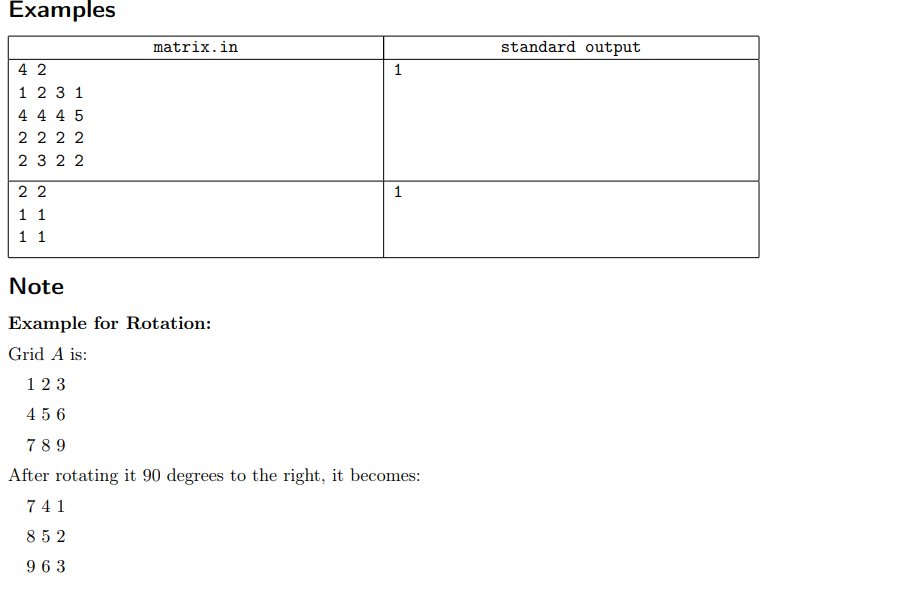
Pour ce problème, on avait en entrée une matrice carrée d’ordre N et il fallait trouver le nombre de matrices carrées d’ordre X contenues dans cette dernière et dont la rotation de 90 degrés dans le sens horaire donne toujours la même matrice.
On cherche donc les matrices Mi dont Rotation(Mi) = Mi.
Prenons l’exemple 1 et vérifions tout les matrices carrées d’ordre 2 valides:









Le plus dur était d’extraire les matrices d’ordre X de la matrice initiale. Pour le faire il faut repérer les cases Mi,j où i + x ≤ N et j + x ≤ N. Après cela il faut rajouter les:
lignes[ i + k ][ j : j+x ] avec K [0:x-1]
La fonction de rotation, elle est assez simple, vous avez dû remarquer que les colonnes deviennent des lignes puis ont les inverse.
SOLUTION PYTHON 3:
import sys


def rotate(g, x):

    rotation=[]

    for i in range(x):
        a=[]
        for j in range(x):
            a.append(g[j][i]) # Transformation de colonne en ligne

        rotation.append(a[::-1]) # inversion

    return g == rotation # 1 si vrai 0 si faux


sys.stdin=open("matrix.in", "r")

n , x = map(int,input().split())

matrix=[]

for _ in range(n): matrix.append(input().split())

resultat = 0

for i in range(n-x+1):

    for j in range(n-x+1):

        mat=[]

        for k in range(x):

            mat.append(matrix[i+k][j:j+x])

        resultat += rotate(mat,x)


print(resultat)
Problem F. Sequence
Sujet
Nobody really likes long statements, so let’s get to the point.
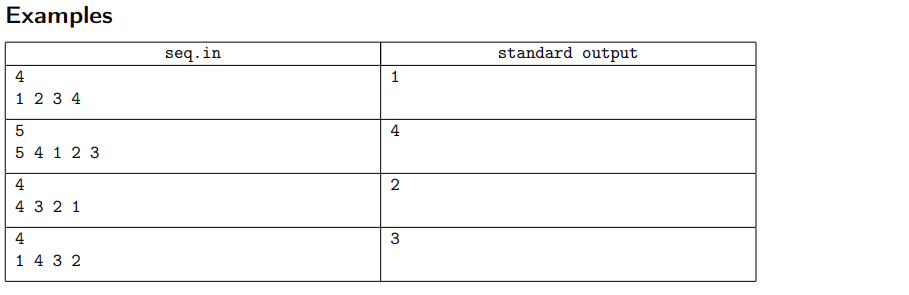
Given a sequence of distinct numbers from 1 to N. There are 4 categories to classify the given sequence:
- Category 1: The sequence is increasing.
- Category 2: The sequence is decreasing.
- Category 3: The sequence is increasing then decreasing.
- Category 4: The sequence is decreasing then increasing.
It’s guaranteed that the given sequence belongs to one of the above categories.
Input
The first line of input consists one integer N (2 ≤ N ≤ 103) - the length of the sequence.
The second line contains all numbers from 1 to N.
Output
Print the number of the category to which the sequence belongs.
Réflexion
Il faut donner la catégorie d’une liste:
-
si elle est dans l’ordre croissant alors Catégorie 1
-
si elle est dans l’ordre décroissant alors Catégorie 2
Si elle n’est dans aucune dans ces deux catégories alors elle est forcément dans la catégorie 3 ou 4. Pour cela il faut comparer liste[0] et liste[1]:
-
si liste[0] < liste[1] alors Catégorie 3
-
sinon Catégorie 4
SOLUTION PYTHON 3:
import sys

sys.stdin=open("seq.in", "r")

n = input()

numbers = input().split()

tri = sorted(numbers)

if tri == numbers:

    print(1)

    sys.exit(0)

if tri == numbers[::-1]:

    print(2)

    sys.exit(0)

print(3 if numbers[0] < numbers[1] else 4)
Problem G. Painting
Sujet
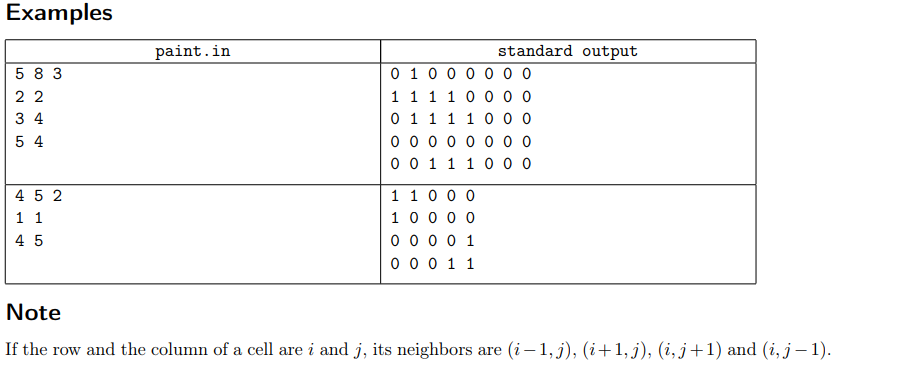
One day, as George was on his way back home, he saw a painting in the street. He discovered that it was a magical painting. The painting was divided into rows and columns like a grid. Each cell was initially colored in white.
Here is the magic, when George touches a cell in the painting, it’s color and the color of its neighbors (if found) changes. If it’s black, it changes to white and if it’s white it changes to black. The neighbors of a cell are the cells that share a side with it.
Given the cells that George touched, you should expect the color of each cell.
Input
The first line contains three integers N, M and Q (1 ≤ N, M ≤ 1000),(1 ≤ Q ≤ 1000) - the number of rows, number of columns and the number of cells George touched, respectively.
The next Q lines contain two integers X and Y (1 ≤ X ≤ N, 1 ≤ Y ≤ M) - the row and the column of the cell George touched.
Output
Print the N lines, each line contains M integers separated by single space representing the grid after the operations.
Print 1 if the cell is black and 0 if the cell is white.
Réflexion
On nous donne une grille de taille N*M et lorsque l’on touche une case, elle et tous ses voisins changent de couleur.
Sachant que toutes les cases sont coloriées en blanc au début, on nous donne une série de cases qui ont été touchées et nous devons afficher l’état de la grille à la fin.
On peut considérer les cases comme des lampes, Si elles sont allumées(1) on les éteint(0) et vice-versa.
Supposons qu’on touche une case de coordonnées i, j;
-
Si case[i][j] est allumée alors l’éteindre sinon l’allumer (Pour cela on utilise l’opérateur ! qui peut être considéré ici comme l’interrupteur)
-
on répète la même oppération pour tous ses voisins que sont (i−1, j), (i+ 1, j), (i, j + 1) et (i, j −1)
SOLUTION C++:
#include<bits/stdc++.h>


using namespace std;

bool colored[1001][1001];

int main ()
{


    ios_base::sync_with_stdio(false); cin.tie(NULL);

    freopen("paint.in", "r",stdin);

    memset(colored, 0 , sizeof(colored));

    int N,M,Q;

    scanf("%d %d %d", &N, &M, &Q);

    for(int i = 0; i < Q; i++)
    {
        int x, y;

        scanf("%d %d", &x, &y);

        colored[x][y]=!colored[x][y];


        colored[x-1][y] = !colored[x-1][y];

        colored[x+1][y] = !colored[x+1][y];

        colored[x][y+1] = !colored[x][y+1];

        colored[x][y-1] = !colored[x][y-1];
    }


    for (int i =1; i<=N; i++)
    {
        for(int j=1; j<=M; j++)
        {
            if( j<M)
            printf("%d ", colored[i][j]);
            else
            printf("%d", colored[i][j]);
        }
        puts("");
    }

}
Problem K. Mango
Sujet
“I wrote the word Mango, mom!”
“Oh, that’s impressive baby girl.”
Little Lama is learning the English alphabet, that’s why her parents decided to order her magnetic alphabet so she can stick them on the fridge. To order the alphabet, Lama’s parents first tell the store how much they want from the letter “a”, how much they want from letter “b”, how much they want from letter “c”… and so on until letter “z”.
Lama wants to write down the string S, can you help her count how much they need from every letter of the alphabet?
Also, can you sort the word S for Lama to make it easier for her to write?
Input
The first -and only- line of input has the string S (1 ≤ |S| ≤ 105) - the word Lama wants to write.
Output
The first line should have 26 space-separated integers, each representing how much Lama needs from each letter of the alphabet [a, b, c, d, e ……. y, z] to write the word S.
The second line of the output should have the string S2 - which is the sorted version of string S.

Réflexion
Pour un mot qu’on nous donne, il faut afficher le nombre d’occurence de chaque lettre miniscule de l’alphabet puis afficher le mot trié.
SOLUTION PYTHON 3:
import sys
import string

sys.stdin=open("mango.in", "r")

s = input().lower()

for i in string.ascii_lowercase:
    print(s.count(i),'' if i != 'z' else '\n',end='')

print(''.join(sorted(list(s))))
Problem K. Mango
Sujet
Homos is a big boy now and he knows that his younger sister: Shambo, has just learnt about mathematical operations. He decided to test her understanding using a little trick. Homos will give Shambo two numbers: X and Y . He is going to let Shambo choose the number N, where:
Then, Homos will give Shambo exactly N cookies. Shambo loves cookies so much, so she wants to have the maximum number of cookies she can get.
Help Shambo determine the value N.
Input
The first -and only- line of input has two integers: X and Y , (−109 ≤ X, Y ≤ 109) - the two numbers Homos will give to Shambo.
Output
Output a single number N - the maximum number of cookies Shambo can get.

Réflexion
On nous donne deux entiers X et Y et nous devons donner le plus grand nombre N que l’on peut former à partir de ces deux nombres en utilisant:
- l’addition
- la multiplication
- la soustraction
La soustraction n’étant pas commutative, il faudra faire attention à vérifier X - Y et Y - X
On a donc:
SOLUTION PYTHON 3:
import sys

sys.stdin=open("trick.in", "r")

X , Y = map(int, input().split())

print(max(X + Y, X * Y, X - Y, Y - X))
Voilà nous sommes à la fin de cet article, j’espère qu’il vous aura plus. N’hésitez pas à le partager et à me suivre sur facebook et twitter pour être au courant de mes prochaines publications.